Race bib resale is growing because lotteries in Europe now turn away most applicants, and the documented cost so far is fraud. On Oct. 11, 2026, Canadian Running Magazine reported that buyers on the informal market risk losing money or paying for an entry that cannot legally be transferred. Organizers, for their part, lose track of who is running.
None of the sources we reviewed gives resale prices or organizer revenue figures. The size of the secondary market cannot be measured, only the demand behind it and the problems it causes.
Lotteries in Paris and Copenhagen draw several times more applicants than places
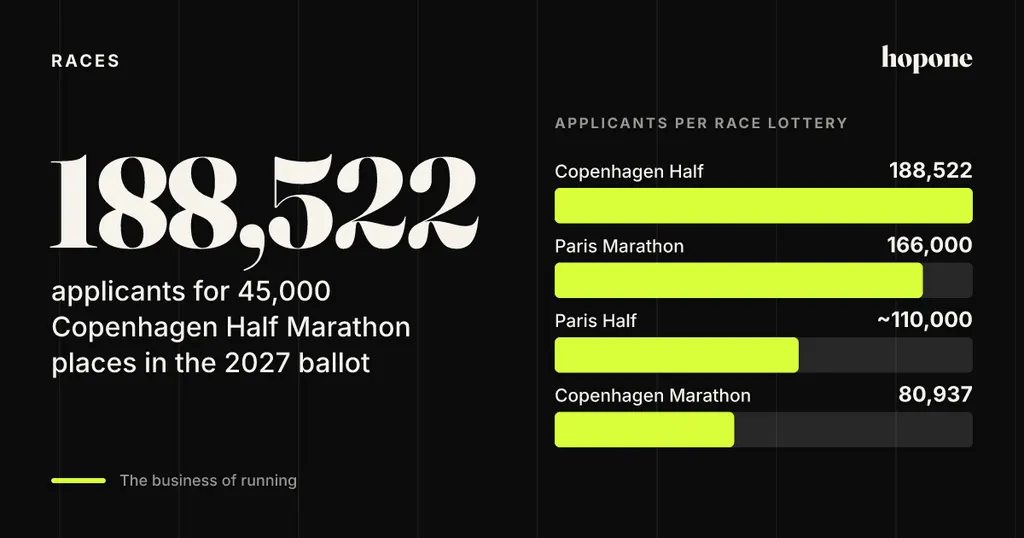
The ASICS Paris Marathon (April 4, 2027, its 50th edition) received 166,000 entries in its first lottery. The HOKA Paris Half Marathon (March 7, 2027) drew almost 110,000 applicants. Applications closed Sept. 30, 2026. We covered the marathon figure in 166,000 runners chase a place at the 50th Paris Marathon.
In Copenhagen, 80,937 people applied for 35,000 marathon places in the 2027 ballot, about 2.3 applicants per place (Hopone calculation). The half marathon is tighter: 188,522 people entered for 45,000 places, about 4.2 per place (Hopone calculation), according to The Copenhagen Post, citing organizer Sparta Atletik & Løb. See 188,522 applicants for 45,000 Copenhagen Half Marathon places.
The Prague Half Marathon's 2027 ballot closed Aug. 12 with more than 70,000 applications, 77% of them from outside the Czech Republic, Marathon Handbook reports. Fast sell-outs, such as Grandma's Marathon 2027 in a record 174 minutes, show the same pressure outside Europe.
Buyers lose money to fake sellers, and genuine sellers can still sell an invalid bib
Montreal runner Leila Mekki Berrada lost $80 to a fraudster while trying to enter the sold-out 2024 Beneva Montreal Marathon. Her bank blocked a second $50 transfer because the seller's name did not match the email account.
Alexandre Ratthé, executive producer of the Montreal race, said 20 to 25 people told organizers they had been scammed ahead of race weekend. Jay Glassman, race director of the Toronto Marathon, said he heard of six bib-related frauds at the May event.
Third-party platforms offer little protection. Bibready, for example, says it does not verify identities or hold payments.
A genuine seller is not always safe either. The buyer may pay for an entry that cannot be transferred, and a fraudulent seller can disappear after receiving an e-transfer. In France, Europe-infos reports that organizers of the Chartres Cathedral Run warn that start corrals, timing and race insurance depend on a properly registered entry.
Organizers lose control over who runs, and data on bib resale losses is missing
Face-value prices set the reference for any resale. Paris charges €169 for the marathon and €79 for the half, according to marathons.com. The Copenhagen Marathon charges DKK 995 plus a DKK 20 fee. The Copenhagen Half charges DKK 795 plus a 5% administration fee. For how fees are set elsewhere, see Dublin Marathon's rise to €130.
Official transfers carry their own fees. Toronto Waterfront charges the incoming runner the registration fee plus a $10 transfer fee, HST and processing fees. Montreal charged $18 plus service fees and taxes for online transfers before Oct. 8, and $30 at the expo from Oct. 8.
A bib sold off-platform bypasses those fees and the organizer's record of who is on the course. Chicago prohibits the sale, trade or transfer of entries, and violations can bring disqualification or a ban. Vancouver says bibs are non-transferable.
Organizers split between official transfer platforms and outright bans
Paris will open an official resale platform from Dec. 1. Toronto Waterfront and Montreal (through Race Roster) run official transfers. Toronto refunds the original participant, less processing fees, and says not to send money directly to that person. Chartres says its official exchange is meant to reduce fake bibs.
Copenhagen went the other way. Marathon Handbook says the marathon shut its resale platform and made places personal and non-transferable, citing fraud on the old system and the rules of the European Marathon Classics group, which does not permit resale. The half marathon says it will have no resale platform, and an entry sold between individuals is not valid. Runners can buy optional Refund Protect from Refundable.me instead.
A LinkedIn post by Giulio Zichella argues that regulated resale can aid fairness. It is opinion, not reporting.
Where each race stands on bib transfers
| Race | Transfer policy | Cost or note |
|---|---|---|
| Paris | Official resale platform from Dec. 1 | No fee reported in our sources |
| Toronto Waterfront | Official transfer | Registration fee plus $10, HST and processing fees |
| Montreal | Official transfer via Race Roster | $18 online before Oct. 8, $30 at expo from Oct. 8, plus fees and taxes |
| Vancouver | Non-transferable | Bibs cannot be transferred |
| Chicago | Sale, trade or transfer prohibited | Disqualification or ban possible |
| Copenhagen Marathon | Personal, non-transferable | Resale platform closed |
| Copenhagen Half | No resale platform | Optional Refund Protect from Refundable.me |
Only transfers made through the organizer's own system are recognized. Informal deals carry the risk.
Sources
- Canadian Running Magazine: Buyer beware: The risks of the race bib resale market
- marathons.com: Paris Marathon 2027: 166,000 runners chasing a bib
- marathons.com: Paris Half Marathon and Marathon 2027: Prices, bibs, new courses...
- Marathon Handbook: Copenhagen Half Marathon Goes To A Lottery For 2027
- The Copenhagen Post: Nearly 189,000 people enter lottery for 45,000 Copenhagen Half Marathon places
- CPH Half Marathon (Sparta): Lottery - CPH Half Marathon
This article was written with AI by the Hopone Newsroom, from the sources it cites. Figures marked “Hopone calculation” are our own arithmetic from those sources. Nothing here is investment advice.