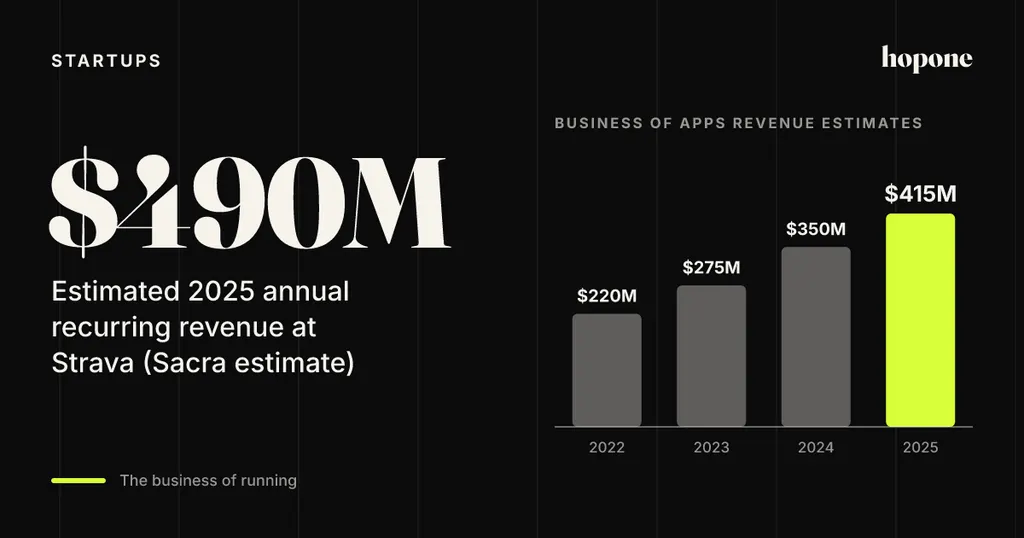
Strava makes most of its money from subscriptions. Sacra, a research firm, estimates $490 million in annual recurring revenue (ARR, the yearly value of active subscriptions) for 2025, up 32% from $370 million in 2024, according to a brief by QuantLogix. The same brief says about 90% of revenue is subscription, with the rest from brand partnerships, advertising and data licensing. These are outside estimates: Strava has not published audited financials.
The company has given one figure of its own. In August 2025 it said it was “approaching $500 million” in ARR, as reported by SQ Magazine. On February 2, 2026, it confirmed it had confidentially submitted a draft IPO filing to the SEC, according to StockAnalysis.
- Subscriptions are the core business: an annual plan costs $79.99 and a monthly plan $11.99.
- Revenue estimates conflict: $490 million (Sacra) against $415 million (Business of Apps) for 2025. None is audited.
- Brand challenges and Strava Metro add revenue, but neither discloses its own figure.
- The latest reported valuation is $2.2 billion, from a May 2025 round. The $1.5 billion often quoted dates from 2020.
- As of October 2026 there is no public IPO filing, date or ticker.
Subscriptions drive an estimated 90% of revenue
Strava has moved toward a subscription-first product, with a free tier for logging and a paid tier for analysis and training tools. The annual plan is $79.99 and the monthly plan is $11.99. A Strava and Runna annual bundle costs $149.99, according to AppMagic.
AppMagic data for August 2026 shows how buyers choose. Annual plans made up about 69.4% of iPhone in-app purchase revenue, monthly plans 24.6% and the bundle 3.9%. Strava earned more than $184.4 million in in-app purchases in 2025 on 47.8 million downloads, and ranked first by revenue among Health & Fitness apps (AppMagic). That figure covers app-store purchases only, so it is not total revenue.
Estimates of total revenue differ. Business of Apps, citing Bloomberg and its own report, gives $415 million for 2025, up 18.5%, against $350 million in 2024, $275 million in 2023 and $220 million in 2022. QuantLogix says third-party estimates for 2025 range from $415 million to $490 million.
| Year | Sacra (via QuantLogix) | Business of Apps |
|---|---|---|
| 2022 | n/a | $220M |
| 2023 | n/a | $275M |
| 2024 | $370M | $350M |
| 2025 | $490M (ARR) | $415M |
How many users actually pay
Strava has not disclosed its paying-subscriber count or conversion rate, according to SQ Magazine and QuantLogix. QuantLogix notes that $490 million at the $79.99 annual price implies about 6 million subscribers. That is arithmetic, not disclosure.
Against 200 million registered users, 6.1 million subscribers would be about 3% (Hopone calculation). Against roughly 50 million monthly active users, it would be about 12% (Hopone calculation). The estimate ignores the cheaper monthly equivalent, the bundle and the non-subscription share of revenue, so it is a rough guide. A diligence report from GenisisIQ puts paying users at 1% to 3% of registered users, but the same page also cites 10% to 15%.
| Date | Reported users | Source |
|---|---|---|
| January 2024 | 120 million+ athletes | SQ Magazine |
| April/May 2025 | 150 million+ registered | SQ Magazine, Forge |
| Late 2025 | 180 million+ | Fortune, Business of Apps |
| Mid-2026 | 200 million+ | Forge, AppMagic |
Monthly active users were about 50 million, roughly double the 2022 level by 2025, according to the Financial Times citing Sensor Tower, as relayed by Forge Global. Registered users include inactive accounts, so they overstate the audience that can pay.
Sponsored challenges turn brands into paying partners
The second revenue line is Strava Business. A brand sponsors a challenge and offers a reward, usually a discount, coupon or prize, for completing an activity such as walking 50 kilometers in a month, according to Strava's business site.
Strava says Sponsored Challenges raise average brand recall by 75%. That is a company claim, not an independent measure. Its case studies include Eight Sleep, with about 56,000 participants, and Specialized Asia, with a 2.21 return on investment and 116,300 first-time participants.
Brands named on Strava's site include New Balance, Le Col, Eight Sleep, CLIF Bar, Chipotle, The North Face and GU Energy Labs. Hopone found no Strava page naming Nike or Brooks as sponsors.
An ad model without exchanges
Strava does not sell programmatic advertising, the automated buying of ad space through exchanges. Its formats are Sponsored Challenges, Sponsored Segments and in-feed promotions. The company restricts challenges mostly to “endemic” brands tied to sport, wellness and nutrition, to keep the feed “non-interruptive”, according to its business guide.
The pitch to brands is intent: users sign up to move, rather than see a banner. The same logic applies to local communities; see how run clubs monetize their communities. Strava does not report what this line earns.
Strava Metro sells aggregated data to city planners
The third line is Strava Metro, which sells activity data to public bodies. According to Strava's Metro FAQ, departments of transportation, planning organizations, cities and trail groups use it to plan bicycle and pedestrian infrastructure. Metro's revenue is not disclosed in the pages Hopone reviewed.
The data is aggregated and de-identified, consistent with GDPR and CCPA, the European and California privacy laws, according to the FAQ. It excludes private activities and deleted accounts. Strava says Metro does not use passively collected cell-phone location data.
Heatmap “heat” appears only after multiple users have traversed an area in the last year. Activities not set to “Everyone” are excluded, as are portions hidden by map-visibility settings. Members can opt out of Metro and the Global Heatmap, according to Strava Support.
Strava says it is profitable, but no audited numbers are public
In May 2025, CEO Michael Martin said Strava had been profitable for more than four years, with free cash flow rising, according to a Yahoo Finance summary of a Catalysts interview. The company also used debt financing with JP Morgan Chase and Wells Fargo, according to the same source. No audited financials are public, so the claim cannot be checked.
Martin became CEO in January 2024 and is the first non-founder to hold the job. He previously worked at YouTube, Nike China and Disney, according to Contrary Research and Fortune. Founders Mark Gainey and Michael Horvath have stepped back, which Strava confirmed to Fortune. Hopone found no source tying the leadership change to the IPO timeline.
A $2.2 billion valuation and a confidential IPO filing
In May 2025, Strava raised a round at a $2.2 billion valuation including debt, led by Sequoia Capital, with TCV, Jackson Square Ventures and Go4it Capital also taking part. Forge lists it as a $50 million Series F-1 at $13.99 per share, with $228.48 million raised in total. The $1.5 billion figure often cited is the 2020 valuation, when a $110 million Series F valued the company at about $1.54 billion.
| Date | Event | Valuation |
|---|---|---|
| Early 2011 | Series A, $3.99M | $13.52M |
| 2020 | Series F, $110M | About $1.54B |
| Late 2023 | Secondary-market price (Forge) | About $1.55B |
| May 2025 | Series F-1, $50M, including debt | $2.2B |
| August 2026 | Forge price of $13.99 per share | About $2.2B implied |
The 2026 figure is a secondary-market price, not a company valuation. One third-party brief says secondary marks softened about 30%. That conflicts with Forge's data, and Hopone could not verify it.
The IPO timeline so far
- September 2025: Reuters reported that Strava was soliciting bank pitches, according to Segmara.
- October 2025: Martin told the Financial Times Strava intends to go public “at some point”, which would ease access to capital for acquisitions.
- January 8, 2026: The Information, via Reuters, reported a confidential filing with Goldman Sachs as lead.
- February 2, 2026: Strava confirmed a confidential draft Form S-1 submission. Share count and price range were not set.
- October 2026: no public S-1, date or ticker exists, according to Forge, CoinCodex and Segmara.
A listing “as soon as spring 2026” was reported but has not happened. Strava has used acquisitions to widen its product: Runna in April 2025 and The Breakaway, according to Fortune, Forge and the WSJ.
I think the market is largely ready.
Michael Martin, Strava CEO, quoted by Fortune
Hopone found no sourced analysis of market appetite for consumer fitness stocks, so it makes no judgment on timing. For more private-company coverage, see the Startups section.
Answers to common questions about Strava's finances
Is Strava profitable?
Strava says so. In May 2025, CEO Michael Martin said it had been profitable for over four years, with free cash flow rising. No audited financials are public, so the claim is unverified.
How much is Strava worth in 2026?
The latest reported valuation is $2.2 billion, from a May 2025 round that included debt. Forge's $13.99 per share price in August 2026 implies about the same, according to Forge. That is a secondary-market price, not a listing value.
Who owns Strava now?
Strava is privately held and not publicly traded. Investors include Sequoia Capital, TCV, Jackson Square Ventures, Go4it Capital, Dragoneer, Sigma Partners and Madrone Capital, according to Forge and Contrary Research. Forge also lists Bow River Capital.
Does Strava sell my personal data to brands?
Strava says it asks permission before collecting personal data and collects health data only with consent. Its data protection officer said it does not share personal data with partners, though users can opt in to share information directly with third parties. Metro data is aggregated and de-identified, and members can opt out.
Sources
- SQ Magazine: Strava Statistics 2026: More Than 200 Million Users, 1 Million Clubs and ARR Near $500 Million
- QuantLogix: Strava IPO 2026 — $2.2B Valuation, 180M Athletes, the Confidential Filing
- GenisisIQ: Strava — Startup Diligence
- Forge Global: Strava Upcoming IPO & Private Stock Price
- Business of Apps: Strava Revenue and Usage Statistics (2026)
- AppMagic: Strava's Record Year Is Past $170M, and It's Not Just AI
- StockAnalysis: Strava Stock Price, Valuation & News
- Segmara: When Will Strava IPO?
- Forge Global: Strava IPO Timeline and Financing Details
- Forge Global: Buy and Sell Strava Stock
This article was written with AI by the Hopone Newsroom, from the sources it cites. Figures marked “Hopone calculation” are our own arithmetic from those sources. Nothing here is investment advice.